
Creative Processes
This section refers to the pre-production documentation of film making. There are four core parts to the creative process and these are:
-
Script
-
Treatment
-
Shot list
-
Storyboard
They are key to laying out the foundations of a film before you begin shooting and editing and good results in this area will likely lead to more success in the box office.

Script
The script is probably the most well known piece of documentation involved in film. They are the foundation that guide the narrative, dialogue, and actions within a movie. They are essential for conveying the story's vision to the directors, actors, and crew, ensuring that everyone is clued up with the plot and character development.
All scripts are formatted in the same way: When a character has dialogue, their name will be in full caps and in the centre of the page. They will begin with a short synopsis and context to the scene for example labelling it as Internal or external, where it is, and what time of day it is, then a short gap before the first line of dialogue/stage direction.
A well written script will significantly aid a film in its success as it means that actors know exactly what to do in order to do what the director and script writers feel is best for that character.
However, if the script is poorly written then the direction is lost. Disjointed writing which can result in a film that fails to captivate viewers or critics, leading to an overall failure.
Dune had a well written script that conveyed the narrative successfully in order to set up the second film. This lead to greater success in the cinema and it being renewed for production of said second film.


Treatment
The treatment is the first thing that is presented to producers, executives, directors, and actors you want to attract to your film, its purpose it to pitch the film. which proposes the ideas you have for the film. It needs to be interesting so that the film actually reaches the first stages of production. If you have a good idea and it is presented well, it is how your film gets made.
Because Dune is based on an already existing book, the process of pitching the film would not have been tedious. However, there was already an attempt to adapt the book into cinema in 1984 which was a massive flop, so Villeneuve would have had to work hard to convince the executives that he could produce a much better film, and that he did.
Shot list
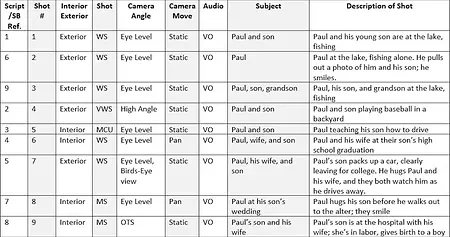
Shot lists outline the specific type of shots you want to be carried out. They can show what the overall style of the film's cinematography is going to be and are largely important in speeding up the process of filming, thus saving some money in production.
Villeneuve had a good idea of the shots he wanted to achieve, filling the movie with close ups to show off features like the Fremen’s blue eyes and establishing shots like when the first spice harvester is shown in the desert to show the grand scale of their mission. As a result of this planning, Dune won best cinematography at the Oscars in 2022.
storyboard
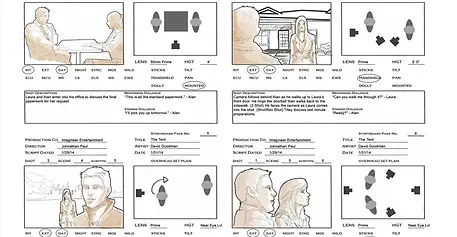
The storyboard is useful because it can be very helpful in showing the actors and anyone else on set responsible for achieving a shot what you want the scene to look like. Many directors will only storyboard the more complicated scenes, however, some will storyboard every scene to ensure their ideas can be fully fleshed out.
On the other hand, storyboarding can take up a lot of time in production, so it may not be a good idea to storyboard the entire film as it may delay production leading to unrest in the fanbase.
Villeneuve would have wanted to separate his production of Dune from the failure of the 1984 rendition, and so would have storyboarded the film differently to Lynch's. Different shots and scenes were implimented so that people remember this film as good cinema rather than another stain on the Dune universe.

Conclusion
Overall, each piece of creative documentations has its benefits to production. However, the most important of them has to be the script. Without a script, the actors are left clueless as to what they need to say and do when filming, and the whole structure of production is thrown under the bus. Whilst a poorly written script can lead to an undesirable viewing, that is going to be the fault of the script writers, rather than the scripts existence. Therefore, good scriptwriters are key to the success of a film.