
Narrative Codes
The story of the film is about two manchildren so driftless in life they don't even realise when the world begins to fall apart:
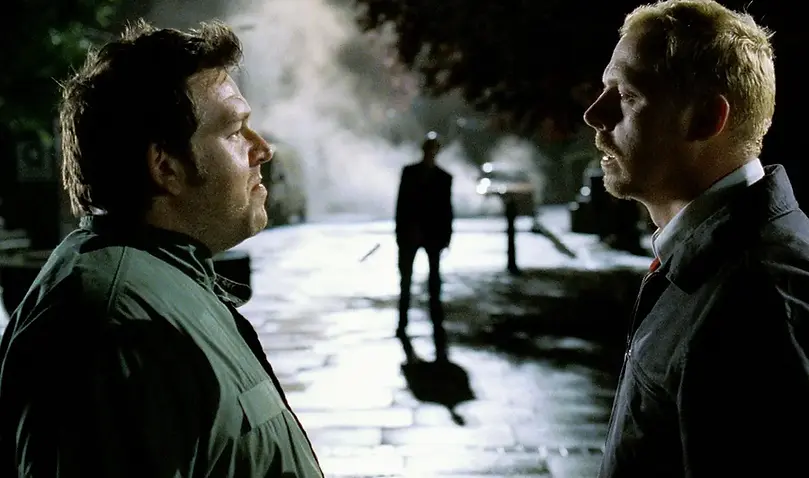
Shaun and Ed live together in a small house somewhere in North London with their flatmate Pete, who is unsurprisingly annoyed at Shaun and Ed's antics of having no job and just going to the Winchester pub everyday. One day Shaun goes out to the shop and wanders through surroundings he's so used to he doesn't realise that a zombie virus has broken out. One of these 'zombies' has wandered into Shaun and Ed's back garden, and naturally the two just think it's a wildly drunk woman. Turns out she is actually the un-dead and a spear through her body leaving her unphased is enough for the pair to wake up to the chaos. Shaun gets a call from his mother saying that his father (played by Bill Nighy) has been bitten so Ed says his now famous reference to Dawn of the dead (1968) "we're coming to get you Barbara". As they collect Shaun's parents, they realise Shaun has to save his girlfriend Liz and her flatmates in an attempt to save their relationship. Once the group is all together they devise a plan to get to their favourite place, The Winchester, and "wait for all this to blow over". On the way, Shaun's father dies in the car in one of this films amazingly acted emotional scenes that fit perfectly in with the horror and comedy aspects. They get into the Winchester after disguising themselves as part of the zombie hoard surrounding the pub (and a distraction from Shaun) and we then learn that whilst the group were hopping fences, Shaun's mum was bitten and Shaun has to tragically shoot his zombie mother. Two of Liz's flatmates are then ripped open by zombies and/or run into the hoard (we learn from a comic strip that she survived) leaving just Shaun, Ed, and Liz to die in the cellar of the Winchester. The three of them see a lift that could take two of them up to the surface leaving Ed to sacrifice himself so that Shaun and Liz can get away. Once they reach the surface, Yvonne (Shaun's ex also played by co-star of Spaced with Pegg) arrives with the army and saves the two. The army eventually tackle the crisis and humanity learns to live with the zombies, including Ed's zombie, who Shaun keeps in his shed to 'play' videogames with

Propp's narrative theory

Hero
Shaun (Simon Pegg)
Shaun is the main character we follow and he is on his quest to save the ones he loves

Villain
Zombie outbreak
The main opposition to Shaun's task, killing a few of the side characters on the way

Princess
Liz (Kate Ashfield)
Shaun's ultimate goal is to rekindle his relationship with Liz in which he ultimately succeeds. It could also be argued that the Winchester is the princess for the part of the film where they are trying to reach it.

Helper
Ed, Barbara, Dianne, David etc
The rest of the group that aids Shaun on his quest. Ed is arguably more important than the others as he has the best relationship with Shaun. David may also be considered a false hero.

Donor
News reporter
The sequence in which Shaun flicks through the channels revealing a criptic message is what reveals to the audience the events in the world

Dispatcher
Barbara (Penelope Wilton)
Barbara's call to Shaun is what ultimatley sends him to help the others
Shaun of the dead uses traditional Propp roles for its characters. Shaun as the male lead with his best friend sidekick and female love interest. The only variation is the villain being a mass of 'people' rather than one sole character, which in the zombie genre will always be the case, you might have other "villainous" characters but to be part of that genre, they have to be present otherwise it just ends up being a general dystopian film. They do this to make the characters roles simpler and easier to understand so that the audience isn't lost trying to figure out who's who. In Zombieland we see a similar sort of situation where Columbus is obviously the hero of our narrative as we begin the film with his rules and how he has set out to survive against the villain (which similarly to Shaun of the dead is also the zombie outbreak) and then later on we are introduced to the lesser roles. The more minor roles in Shaun of the dead are performed well such as a stunning performance from Penelope Wilton as Barbara who provides the right amount of comic relief and heart wrenching emotional scenes. If we compare this to Zombieland, most roles are also quite obvious with Columbus (played by Jesse Eisenberg) as the clear hero, and Wichita (Emma Stone) performed well as the princess.
In other genres this varies though, in The Unbearable weight of massive talent Lucas (Javi's cousin) is the main villain, which deviates from the two other films where a group is the villain rather than just the one person here. This film may have chosen to do this because Javi's cousin acts as an opposite to Javi (who spends a large part of this film fanboying over Nick), which makes more sense narratively than a horde of people. Despite this, the mafia that follows Javi's cousin do act as a villain, they just play a secondary part as none of their characters are as fleshed out. In the unbearable weight of massive talent, whilst the hero is obviously Nick Cage, the villain is a little less obvious because of Nick's 'princess' being his desire for success rather than a physical person or thing. This direction may be due to the way a story is set out to be told, in a zombie film you are more likely to have the villain be the outbreak but that doesn't really work in a film about a failed actor attending a rich fans birthday party and then fighting off the mafia.
Todorov's narrative theory
Equilibrium- Shaun and Ed living together in the flat
Disruption- Zombie outbreak
Recognition- Shaun and Ed go out to save Shaun's
parents and Liz and her flatmates
Attempts to resolve- The group venture to the Winchester
New equilibrium- Humanity is living with the zombies
Shaun of the dead follows Todorov's proposed pattern pretty closely, beginning at a normal point in a world absent of zombies and ending in a world that has normalized these zombies. However what is interesting about it is one of the messages behind the film is that the world was depressing and full of zombies already which makes the structure pretty cyclical, which is why it took so long for Shaun or Ed to realise anything had changed. The title sequence shows a group of people walking in zombie-like fashion.
Zombieland- the equilibrium of the movie is the world in chaos as we follow the characters whilst they are in the apocalypse rather than the beginning of it, and we end in that same state just with the main crop of characters in a temporary settlement. This is another case like with Propp where the same genre tends to conform to the same sort of situation, very few zombie related media will end with the outbreak ending. We get close in Shaun of the dead but even then the zombies are still roaming the earth, they've just been contained
The unbearable weight of massive talent is similar in this sense to Zombieland as its equilibrium is Nick Cage struggling, but like in Shaun of the dead it ends with a resolution with Nick finding a way to reconcile with his past and embracing his fame and personal life. While the film's narrative and self-referential nature may not follow a linear story structure, it does incorporate elements of disruption, recognition, attempts to repair, and a form of restoration or acceptance, albeit in a more unconventional and self-aware manner. This compares to Shaun of the dead which has a similar structure, yet obviously differences in what happens in them. The resolution is more about how humanity recovered quickly from an apocalypse, which offers a more realistic spin on most zombie films which often end in humanity being doomed. Often in comedy films there is a conventional structure that they follow like in 2008's Tropic thunder, the characters follow a very linear structure which suits the comedy aspects as it allows for jokes to be fleshed out.
Action codes- Shaun's actions in this film are all sequenced, like his decision to rescue his mother and then his girlfriend, or even when he is going to the corner shop (on both occasions). They serve the purpose to create meaning or to move the plot forward
Enigma codes- Throughout the movie there is a sense of mystery as the audience is kept guessing about how the story might unfold. There are several moments in the film where the future is hinted at and then called back to when they happen e.g. Shaun closing the cupboard door to reveal his flatmate once when he is alive and then again when he is "zombified" in the shower
Semantic codes- There's a lot of symbolism regarding the monotony of Shaun's life before the outbreak contrasted with the chaos afterward. The setting, characters' behaviour, and even small details carry symbolic significance such as the red smudge of ink on Shaun's shirt that references the blood that will be on his shirt later.
Symbolic codes- Probably the biggest overarching symbol in the film is the zombies as a way of portraying society as already monotonous like a zombie and that an outbreak of an infection like this would ultimately not change this. The Winchester is the biggest symbol of hope and safety for the characters as it is where Shaun believes their best chance of survival will be, probably due to his character and how he is presented.
Cultural codes- Shaun of the Dead is rich in references to other zombie films and popular culture, things like Ed saying "We're coming to get you Barbara", referencing "Night of the living dead" (1968) or the part in the movie where Shaun and his friends arm themselves with improvised weapons, resembling the style of the "Resident Evil" video game series, which they were playing earlier. This adds depth for audiences familiar with those references.
Barthes Narrative theory

Most films are likely to follow narrative theories from both Propp and Todorov respectfully, and even if they arent aiming to they may follow them subconsciously as they are so applicable. There will be obvious differences between how different films utilise these theories, for example a hero could be just the main character we follow rather than someone who actually 'saves the day' like in Shaun of the dead, where it's really Yvonne and the army who stop the zombie outbreak.
This could be due to the fact that film studios want to stand out so rather than having a traditional "hero save the damsel in distress" that we've seen a million times in Disney and what not, they try to create a movie that still follows the narrative norms of film but sticks out in its own right. Audiences may play a role in this decision also, Shaun of the dead's target audience will be adults and they will know that they've already seen a traditional story in films so will try to interest them by being different, but superhero films that are aimed more towards younger audiences are more likely to follow the hero saves princess narrative because its effective, easy to replicate, and simple for younger audiences to understand. In a film like The unbearable weight of massive talent, the meaning of each part of the narrative is deeper than just a surface level 'hero' or 'princess', and having less prominent changes that get the story from the equilibrium to the new equilibrium.
Conclusions


Shaun of the dead- Ending scene
Zombieland- Pacific playland
TUWOMT- Paddington 2 scene

Back to top