
Finance
Films often have different models of how they gather funding for the production process. There are five main ways that they do so:
Conglomerate funding- This is where a conglomerate company funds the movie. This will usually wield the highest budgets as companies like Disney who fund the big projects have a lot of money, a lot of the time it's simply as much as the producers need.
Co-funding- This involves making a deal to sell your products at a reduced rate to a distributor, and in return the distributer gets to keep a portion of the profits. This can wield larger budgets but the obvious drawback is that you wont receive all of the profits.
Crowdfunding- This is where the general public donate their own money to fund film production. Usually they don't get very large budgets, however it means the directors don't have to fork out of their own bank accounts and a lot of the time they will be supported by another company. The biggest example of this would probably be The Babadook.
Private funding- This is where a business will specifically provide funding to producers to make a project that they want. They can wield higher budgets depending on the wealth of the investors and how badly they want the project to be made.
Charity funding- When a charity is set up for donations and then they are used to provide a film usually for promotion of that charity. They usually wont wield massive budgets.
Depending on the type of project you are aiming to make different ways of funding can be the best option for you. Big blockbusters like Dune will find more success using conglomerate funding because the higher budgets will ensure peoples expectations are met, whereas more indie films will benefit better from Co-funding or charity funding because they don't have as much expectations as the triple-A films to produce visually stunning films, and can be more likely to profit on a lower budget if the film exceeds expectations. However, it could be argued that a film like Dune that is based off of a widely popular book series and is looking to trump the old film made could have benefitted from crowd-funding to further increase their budget because demand for the film was great.

Dune was funded through conglomerate funding from Warner Brothers and Legendary entertainment.



Dune is a triple-A film produced by Denis Villenueve and is an adaptation of the beloved books written by Frank Herbert in 1965. As a result of this level of fame and anticipation for a remake of the underwhelming Dune films from 1984, they had quite a large budget of around $165,000,000 from conglomerate Warner Brothers which allowed them to make a much better film than the already low bar set by David Lynch and making a Gross worldwide of $407,573,628, suggesting that conglomerate funding was the perfect move for the producers of Dune.
But what is this budget used on?

Equipment/Kit:
It filmed on
-
Arri Alexa LF IMAX, Panavision H-Series and Ultra Vista Lenses
-
Arri Alexa Mini LF IMAX, Panavision H-Series and Ultra Vista Lenses
And was produced onto film. These cameras will set you back around $1000-1800 per day. So for 5 months of filming this was roughly $152,000 to $273,600, which is relatively cheap for a film of this size.


Props:
Dune is a sci-fi film that leans heavily on its use of props. For example the ring that Paul receives or the suits that they wear to recycle water on Arrakis. The props had to match the brutalism of the city so seem futuristic yet dated at the same time. These high quality costumes were designed by Jaqueline West.
Locations/set
the setting of the Arrakis desert was mainly filmed in Jordan in the Wadi Rum desert. Caladan's exterior shots were filmed in Stadlandet, Norway. The studio used to shoot in was Origo film studio in Budapest, Hungary. Filming on location usually means you can save money unless the land is protected

Crew:
IMDb says that additional crew size was 146 and 51 people were involved in sound. The large size of crew is down to the scale of the movie. The large budget meant that the producers could hire much more staff to improve the production


Special effects:
Naturally in a sci-fi movie, whatever effects they cannot do practically they outsourced to Paul Lambert (Not the footballer) who was put in charge of the visual aesthetics.

Actors
This star studded cast will have cost Warner Brothers a significant portion of the budget. Actors like Timothee Chalamet, Zendaya, Jason Momoa (These 3 pictured below), Oscar Isaac, Stellen Skarsgard, Josh Brolin, Dave Bautista and more. Timothee alone allegedly cost $3 million.
Catering:
Because of the large crew size and the five months it took to film, a substantial amount of money would have been spent on feeding them. This is a law on film sets for the crew to be spent


What is the most important use of budget?
Actors. Without them you have no film. No dialogue, no on screen action, nothing. However it shouldn't be what the majority of the budget is spent on. In the case of Dune, only 1.818% (3 million) of the entire budget went on actors, and that was for a star studded cast. Most likely, the largest portion of budget will go on hiring the different sets and props needed for the actors to do their job in. Again in Dune, they wanted to film the scenes in the Arrakis desert in the Wadi Rum desert in Jordan, which is a government protected area meaning they couldn't just show up and film, they would have had to get permission which would have costed them a portion of the overall budget.


Effect of funding on each sector
Equipment
If a film uses a funding technique that tends to wield lower budgets then they will have to use lower quality equipment. A film that was funded by charity will not be able to use an IMAX camera.
Location/sets
Some films may be influenced by the funding to film on certain locations or in certain sets. A private funder may request the producers to film at a certain place because they believe it will be beneficial and because they fund the film they have the power to make this decision
Props
Quality of props are going to be affected by the budget provided by the funding. Conglomerate funding will allow for more realistic and better looking props whereas crowdfunding for example might lead to very cheap props that will more than likely look worse or be called out by the audience. For example in The Shining where a cheap axe prop was used and it appears rubbery.
Special effects
We've all seen a film with poor special effects and this is heavily influenced by the funding. Higher budget films funded through conglomerates like 1982's ' The Thing' are able to produce high quality and intricate practical effects (for the time at least), and lower budget films funded mostly by the director themselves like 'Birdemic 2010' ($10,000) suffer from awful visuals especially on the birds
Actors
Actors is another thing that private funding can influence, in the same way it can influence locations/sets. But this influence can also come from charity or crowdfunding. A charity may ask for a certain actor to be cast in a role because they feel they embody the charities values and can deliver their message effectively.

Tracking cashflow is an important aspect of film documentation. It allows the producers to stay within budget and should they need to go over, they can make sure it is kept to a minimal amount.
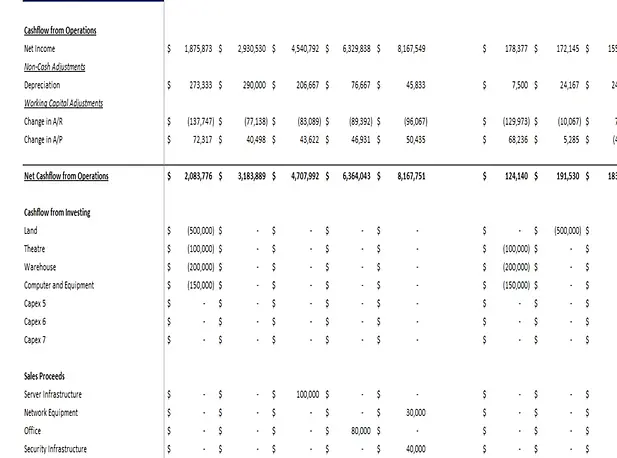
Here is a general template of how producers would keep track of their spending, as well as there sometimes showing net gains/losses