

Stylistic codes are often used to convey meaning. An establishing shot to show our hero right away or a sinister, dark opening to convey mystery and leave the audiences ideas in the air to keep them hooked. Every film will have some sort of style to them that allows them to stick out to an audience and be memorable
Cinematography
The camera work in Shaun of the dead is one of its most prominent features that gets a lot of praise.
Look at this opening scene and see how Edgar Wright frames the introduction of each character chronologically in terms of importance. opening with Shaun in this close up shot immediately establishes him as the lead character and his characteristics of smoking and drinking and not quite there mentally, shown by him not making eye contact with the viewer. Shots like this show the details of a person and in this example, outlines their personality and main characteristics.
In this second clip we have the first of many of Edgar Wrights famous "hyper-quick shots" that he uses throughout the entire cornetto trilogy and other films he has been a part of. In this example it is a montage to show Shaun's variations of plans. The quick pans up and down between shots creates the sense of urgency and confidence from Shaun that this plan will be successful. As the plan gets re-written over and over again, the cuts get quicker, and the scenes get shorter, increasing the audience retention as they do not get tired of the same scene replaying multiple times.
Stylistic Codes
Shot types
Close ups- As previously mentioned, close ups help to establish characters. Starting the movie off with such a close up shot of the character sets the tone for the movie. Wright drops us straight into a tight and uncomfortable situation where we are face to face with someone we don't know who is drinking and smoking on top of us.
Mid-close ups- These shots are like the close up but allow more freedom for the background to be seen as well as the characters. In this example, the casino machine in front of Ed shows his character to be possibly a gambling addict, a convention of many avid pub-goers in England. His proximity to the machine also helps to convey this.
Mid shots- In the intro sequence we see an abundance of mid shots, this on on the right shows the rows of monotonous workers (the main focus being the woman that Ed and Shaun discover in their garden later zombified) and implies the messages that we all serve a purpose to repeat mundane tasks everyday.
Long shots- These are usually uses to show the background rather than focusing on one character. Here it shows how the world has fallen apart in such a a short time, including the innocent children. It conveys the idea that our society is so easily broken down that the children's innocent world is destroyed just as quickly as the rest of it.
Frame within a frame- This type of shot has become synonymous with Edgar Wright as he uses them several times in this film as well as the rest of the cornetto trilogy. Their purpose it to involve the audience in showing what the character sees rather than just cutting straight to the focal point.
Tracking shots- Tracking shots in this films are used so that the audience feels as if they are following the group on their journey. When they are travelling to the Winchester through back alleys in a 1-by-1 formation, it helps to immerse the audience and make them feel included in the adventure.
Panning shots- Wright uses panning shots often for over dramatic reveals that usually end up tricking the audience like near the beginning of the film when we get a shot of someone's feet moving slowly towards the camera and the person making low groans, the audience expects it to be a zombie and then it turns out to just be a lazy Shaun.
Low angles- These portray moments of empowerment. For instance, Shaun, in the scene where he is surrounded by zombies is shown in a low angle shot as he rises to face the undead, symbolizing his determination and strength despite the dire situation. Contrastingly, the character of Ed is captured in a low angle shot during some comedic moments, adding a sense of exaggerated power to his antics.
High angles- These shots are employed to depict pretty much the opposite to a low angle. When Shaun has to consult his mother when he finds out she was bitten, the camera adopts a high angle perspective, emphasizing their emotion in the situation.
Camera shots also play heavy roles in Zombieland, as well as The unbearable weight of massive talent. Most shot types are used for similar reasons, like in Zombieland, whenever there is a close up, it is usually used during moments of tension and is there to build on that feeling. The unbearable weight of massive talent, due to its different genre, uses close ups to focus on emotional scenes or to focus of the subject of a joke being told.


Editing
Perhaps the most notable thing about Shaun of the dead is its incredible editing style throughout the whole film:
Quick cuts- These feature very frequently throughout the movie in Edgar Wrights signature quick cut montages. The film utilizes rapid cuts and quick transitions to create a fast-paced, energetic flow. This technique is best used during action sequences or scenes where Shaun is going about his routine, emphasizing the chaos or monotony of the situation.
Match Cuts- Edgar Wright employs match cuts to connect different scenes or elements thematically. For instance, there's the scene where Shaun's monotonous morning routine seamlessly transitions from one activity to another, showcasing his repetitive and unchanging life.
Pacing- The editing rhythm in Shaun of the Dead contributes to its comedic timing and overall pacing. The precise timing of cuts and transitions enhances the humour and tension in different scenes. It is important for the style of the movie that it follows this pace otherwise it might lose some of its uniqueness which makes it so special.
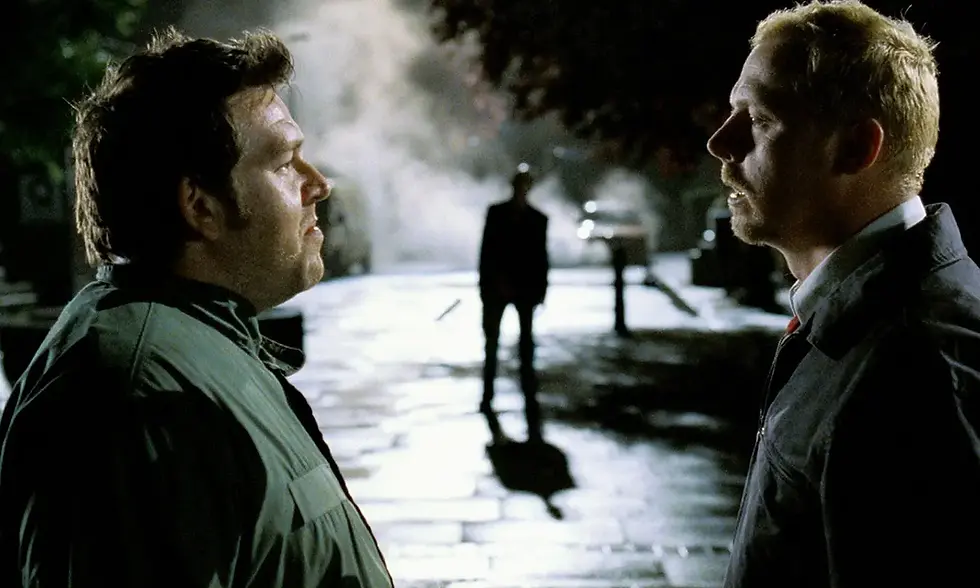
Shot reverse shot- These are a very common feature of narrative films and are often used to show a conversation like they are for the most part in this film.
When this is compared to Zombieland's editing, the lack of Edgar Wrights signature editing style makes it harder for the films editing to stand out as much. One of the ways it tries to do this is with the text that pops up on screen and often interacts with the scene like at the start when Columbus is explaining his set of rules. This gives a sense of uniqueness and makes the text more involved in the world.
As for the unbearable weight of massive talent, the most its editing does to help the film is for comedic effect like a cut to match the joke. This is common for
the comedy genre as a whole in film like tropic
thunder where we see comedic cuts similar to


Sound
Soundtrack- There was no single composer for the soundtrack of this film. The main theme that plays during the title card (linked on the right) enhances the overall atmosphere and complements the eerie visuals, further engaging the audience and establishing the film's tone. The song, now heavily connected with the film, uses a haunting melody to foreshadow the events of the movie.
The biggest needle drop of the movie comes in the form of Queen's "Don't stop me now" used when the group are defending themselves in the Winchester. The song has made this scene of the most memorable and iconic in the whole film. The song choice is brilliantly juxtaposed with the chaos happening on screen. As the songs upbeat and energetic tune plays, Shaun takes on the zombies in another one of Wrights quick cut montages. The scene is choreographed to match the rhythm and tempo of the song, creating a darkly comedic and action-packed sequence.
Dialogue- While the tone of voice of the characters is largely the same throughout the film, in more emotional scenes like where Shaun is weeping over the death of his father (as well as later his mother), is brilliantly acted by Simon Pegg and doesn't ever feel out of place.
Sound design- The film makes a great use of sound design to improve the film. Sound effects often link with the editing like in the morning quick cut scene, sounds of Shaun brushing his teeth and spreading jam on his toast are closely edited to match the editing. More generally though, diegetic sounds such as footsteps or zombie sounds enhance the horror of the film.
Mise-en-scene


Costume- the use of characters costumes in the film is used to connote their characters. Shaun's now famous white shirt and red tie connotes to the normality of his character as he goes through the zombie apocalypse in his work uniform. As the film goes on his outfit becomes more blood stained, referencing the repeated line throughout the film, "you've got red on you".
Ed, in a similarly normal style, wears a more casual and slacker-style wardrobe, often seen in graphic tees and hoodies, which reflects his laid-back personality and his reluctance to grow up or take responsibility. However, after he is 'zombified' his outfit becomes blood-soaked and dirty to reflect the disgusting nature
of the zombies.
Lighting- The films use of high-key lighting in the beginning of the film establishes the normality of the world, the natural looking environment is neither dark nor vibrant. As the film goes on though, the lighting progresses to become more low-key to show a more dramatic and eerie environment.


Props- Some of the most prominent props in the film are: Shaun's bat, Shaun's vinyl records, The Winchester Shotgun, and Ed's Cornetto ice cream.
The bat becomes a symbol of Shaun's character as he uses it as his weapon of choice (until he finds the shotgun) and is sometimes interpreted to show his unwillingness to grow up as he uses an item widely associated with leisure and childhood to take down this life threatening danger. The vinyl records may also show this feature of Shaun's character as he is reluctant to get rid of most of them when deciding which ones to throw at the zombies in his back garden. The Cornetto is also important because it is the start of a running gag that Edgar Wright placed in all 3 of the "Cornetto trilogy" movies Which symbolise the themes of each film, here we have a red cornetto symbolising the bloodshed in the zombie apocalypse.
Props also come to be important in the films "Zombieland" and "The unbearable weight of massive talent":
Zombieland- Weapons (as is natural in a post-apocalyptic setting) become synonymous with the character that wields them. Columbus' Shotgun is the more conventional weapon he uses, but in the store Tallahassee uses a banjo, which adds the comedic elememts of the movie. As well as weapons you have the "Zombie kill of the week" trophy that appears in the movie, which adds to the more modern, social media oriented world of the movie. Props play large roles in the zombie genre as a whole because the weapons that characters wield become synonymous with that character like in the walking dead with Negan's bat Lucille.
The unbearable weight of massive talent- As for props used in the movie, considering it's a film about Cage playing a heightened version of himself, there are various items referencing his career and famous roles. Props such as iconic costumes or replicas from his movies, memorabilia from his career, or items that reflect his Hollywood persona, like sunglasses or quirky outfits. In the comedy genre as a whole the props also can become a symbol for that film like with Happy Gilmore's hockey stick putter, that symbol is recognised as being linked to the film.

Back to top